Thought leadership ads on LinkedIn: how to create posts worth amplifying
Thought leadership ads on LinkedIn are everywhere right now, and for good reason.
They feel more native than company page posts because they come from a person rather than a brand.
That alone changes how people perceive them. The post looks closer to a typical LinkedIn update, carries more personality, and often feels more credible in the feed, even when promoting the same ideas and assets.
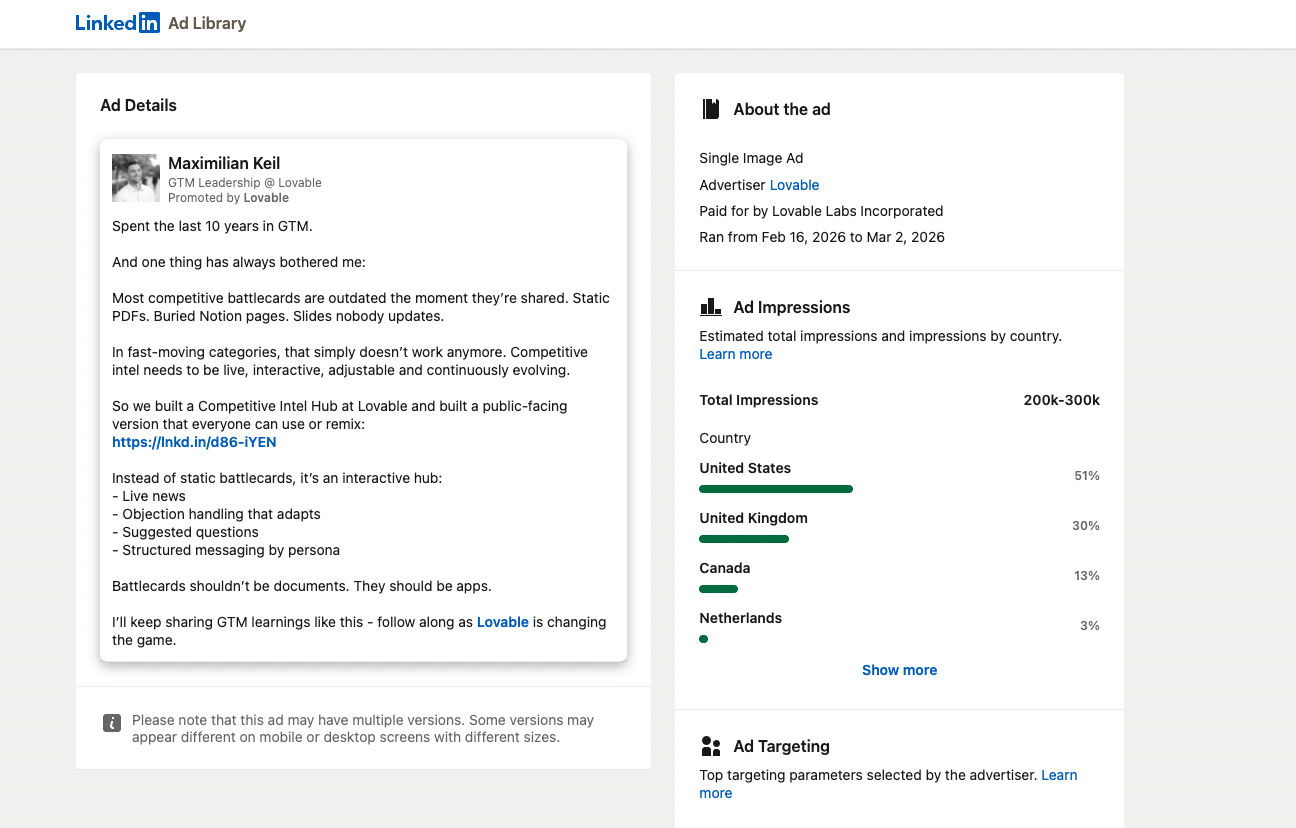
And if you’re not quite clear how to tell them apart from regular ads, here’s a quick visual example (check for the “Promoted by Lovable” tag under the person's job title:
ZenABM’s recent ABM benchmark report confirms that the strategy of promoting these posts isn’t just what looks better creatively, but it also enables marketers to stretch their LinkedIn ads budget much farther.
The 2026 edition of the report highlights that Thought Leader Ads (TLAs for short) delivered a median CTR of 2.68% and a median CPC of $2.29, versus 0.42% CTR and $13.23 CPC for single image ads posted or amplified by the company page, making TLAs dramatically (6x~) more efficient for clicks.
But just because you can promote existing posts from employees and founders doesn't mean that they’re actually written in an optimised way that engages your target accounts.
This quick article covers the best components of successful thought-leadership ads on LinkedIn, the difference between founder-led and employee-led posts, guidance on setting up your TLA campaign in your LinkedIn Campaign Manager, and finally, a few examples of ads you can get inspiration from.
Why thought leadership ads work on LinkedIn
The core reason is simple: people trust people more than they trust brands.
And we’re seeing the proof in the data, too. Have you noticed how company page posts, well, often fall flat when it comes to organic reach?
While sometimes a comment posted on another person’s post will gain more impressions than a post you publish on your feed.
That’s the LinkedIn algorithm right now, and the best plan of action is to use it to your advantage.
A founder or subject-matter expert can say something in one line that would feel flat or self-promotional if posted from a brand account. Thought Leader Ads tap into that natural advantage.
However, that does not mean every personal post should be promoted.
The strongest thought leadership ads on LinkedIn feature organic posts that have:
a clear point of view
a useful insight
a strong hook
a natural human voice
A few TLA (thought leadership ad) examples from LinkedIn
Here are a few examples from recent thought-leadership ads that I've seen from B2B SaaS and AI brands that work really well.
1. Maximilian Keil / Lovable: strong because it reframes a known problem
This is the screenshot I shared at the start.
This example works because it starts with experience and tension:
“Spent the last 10 years in GTM. And one thing has always bothered me…”
That opening instantly feels human. Then it moves into a sharp market observation: battle cards are outdated the moment they are shared. From there, the post introduces a better way of working.
Why it works:
clear personal voice
starts with frustration, not promotion
introduces a bigger idea
explains the product through a market problem
This is a very good example of an operator-led thought leadership ad where the insight is the main event, not the announcement.
2. Kamal Hathi / Splunk: good for partnership proof, but more announcement-led
This one is useful because it shows a more executive, corporate-friendly version of a thought leadership ad.
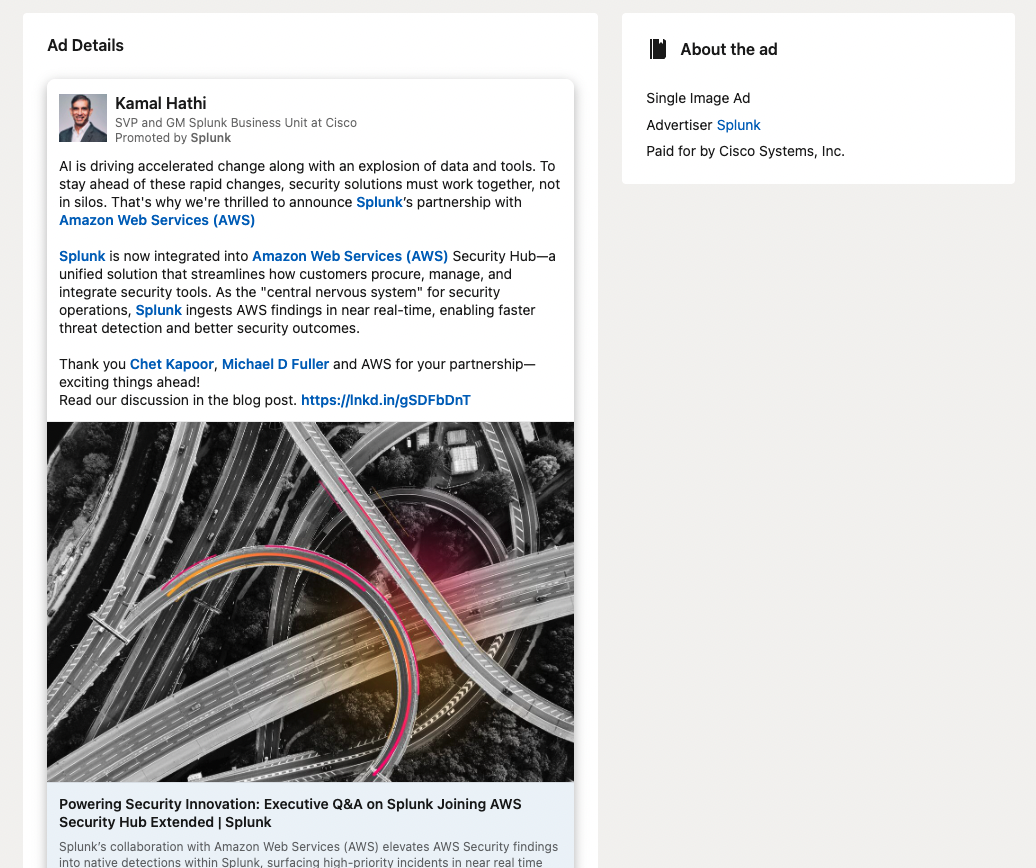
The credibility is strong: senior leader, major brand, major partnership. While the post is more announcement-driven than insight-driven, this is the best type of partnership announcement post you can make (bar a successful case study).
Why this still works as a TLA ad
recognisable person and company
credibility from the AWS angle
image reinforces the message
reads like executive endorsement
includes tags to the people involved, making it easy for people to reach out
3. Gabe Rogol / Demandbase: strong because it turns company news into category commentary
This is a great example of how to handle recognition or award-based news, even if the link preview was broken (likely due to the LinkedIn Ad library than the actual post).
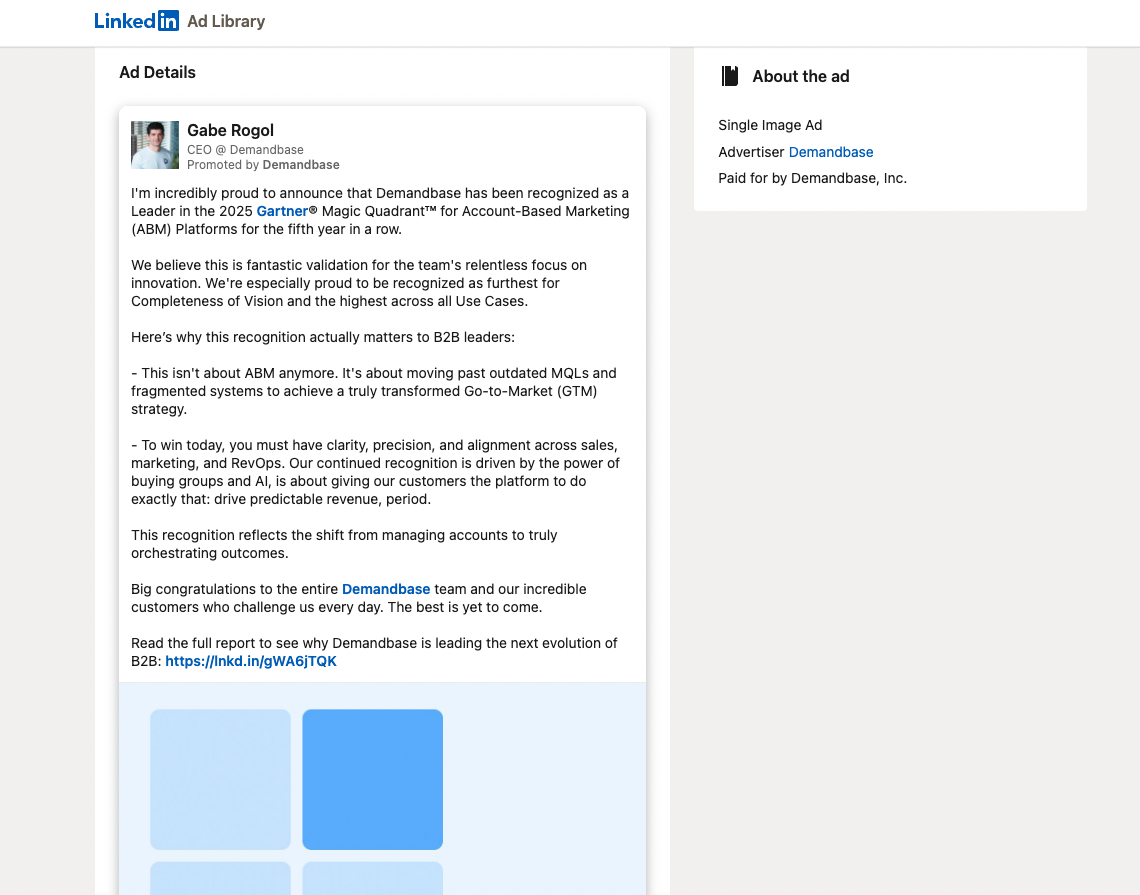
Instead of stopping at “we were named a leader,” the post quickly pivots into: here’s why this matters for B2B leaders.
Why it works really, really well:
starts with a business milestone (fifth year in a row)
then broadens into a category-level point of view
links the company news to a market shift
makes the post useful even for readers who do not care about the award itself
That is a smart thought leadership move. It turns a PR moment into a strategic narrative, amplified across the LinkedIn platform.
Founder-led vs employee-led vs customer-led thought leadership
These should support the same company narrative, but they should not do the same job.
Founder-led thought leadership
Founder-led posts should carry the sharpest point of view.
This is where you challenge assumptions, reframe the category, say what buyers are getting wrong, or share a lesson that only comes from being close to the market.
Strong founder-led topics include:
what the market misunderstands
why a common way of working is broken
how your view changed after building in the space
where buyers waste time, budget, or energy
Employee-led thought leadership
Employee-led posts should feel closer to the work.
These often come from people in GTM, product marketing, sales, customer success, delivery, or operations who can speak from lived experience.
Strong employee-led topics include:
recurring customer questions
patterns seen in demos or implementations
mistakes teams make before buying
practical lessons from the field
Customer-led thought leadership
Well, technically, more social proof than thought leadership, but some customers are so good at sharing their story and success that it’s highly beneficial for you to reach out and get permission to share their posts as ads.
The best customer posts for thought leadership include:
the step change or before and after
behind the scenes of the implementation
relatable story to other peers, ideally where they were hesitant at first
To summarise:
Founder-led content shapes the narrative.
Employee-led content adds texture, specificity, and trust.
Customer-led is the cherry or icing on top of the cake - if other people unaffiliated with the company are seeing value, maybe your prospect should also pay attention.
Together, they give you a much stronger pool of posts to turn into thought leadership ads on LinkedIn.
A simple framework for writing stronger LinkedIn posts
A simple structure works best:
Hook: start with a pain point, tension, surprise, or contrarian observation
Insight: say what most people miss
Proof or example: make it concrete
Takeaway: leave the reader with a useful conclusion
Example #1 — focused on state of industry (cybersecurity)
Weak:
Workspaces have arrived
Stronger:
The problem with “AI will replace the analyst” messaging is that it misses how security work actually happens.
Most teams are not struggling because humans are involved.
They are struggling because good people are buried in repetitive steps, disconnected tools, and too much noise.
AI should remove friction. It should not remove judgment.
That is the difference between flashy automation and something teams will actually trust.
Example #2 (new product launch for a MarTech tool)
Weak:
Feature X (Workspaces) has arrived!
Stronger:
One of the biggest blockers in multi-brand social media management is not strategy.
It is structure.
When teams manage multiple brands, locations, regions, or clients from a single account, things get messy fast. Permissions get awkward, collaboration gets harder, and teams end up relying on workarounds.
Over the last year, we shipped a lot for our customers: from Zapier integration, to better custom tags, to simpler white-labeling for teams that want to brand the platform as their own.
But the update that stands out most to me is Workspaces.
You can now create separate Workspaces for each brand inside your Y account, with no cap on users or seats.
So instead of limiting access or forcing teams to work from one crowded setup, you can invite the whole team in and give each brand its own space.
Sometimes the best product updates are the ones that remove friction from the way people already work.
How to create thought leadership ads on LinkedIn
Create your Campaign Group, then choose the Engagement objective for your campaign. Thought Leader Ads must use existing posts from individual profiles, and LinkedIn supports them under Awareness or Engagement objectives, rather than the most commonly used Website Traffic objective.
In the Campaign setup, make sure to use a matched audience consisting of your Target Accounts or a carefully curated audience targeting settings that you've used for other cold or top-of-funnel campaigns.
For Ad creation, select Single Images as this content type allows sharing text-based posts, posts with link previews, or a single image.
Once you’re at the Ad selection stage:
choose your strongest founder or employee posts
get approval from the post author where needed
add those existing posts to the campaign
pair them with single-image ads in the wider campaign mix if required
Single image ads are a very useful starting format because they are flexible and easier to test at scale. They let you work with text-led creative, image-based creative, and link-preview style creative in the same campaign.
Ready to take on TLAs for LinkedIn?
The best thought leadership ads on LinkedIn don’t start in Ads Manager.
They start with a strong organic post. That means, you need to work with your founders, employees and even sometimes customers to create LinkedIn posts that have:
a human voice
a clear point of view
a useful insight
a post that teaches, reframes, or sharpens thinking
When you have a collection (3-5 ads to start), the distribution you get with paid will help the right audience to actually see your content.